
News & Insights · Utility & Data Center · Insight
Firm Power for AI Data Centers: Pairing Solar and Storage With Fuel-Based and Geothermal Generation
 By Ernie Delgado
· · 4 min read
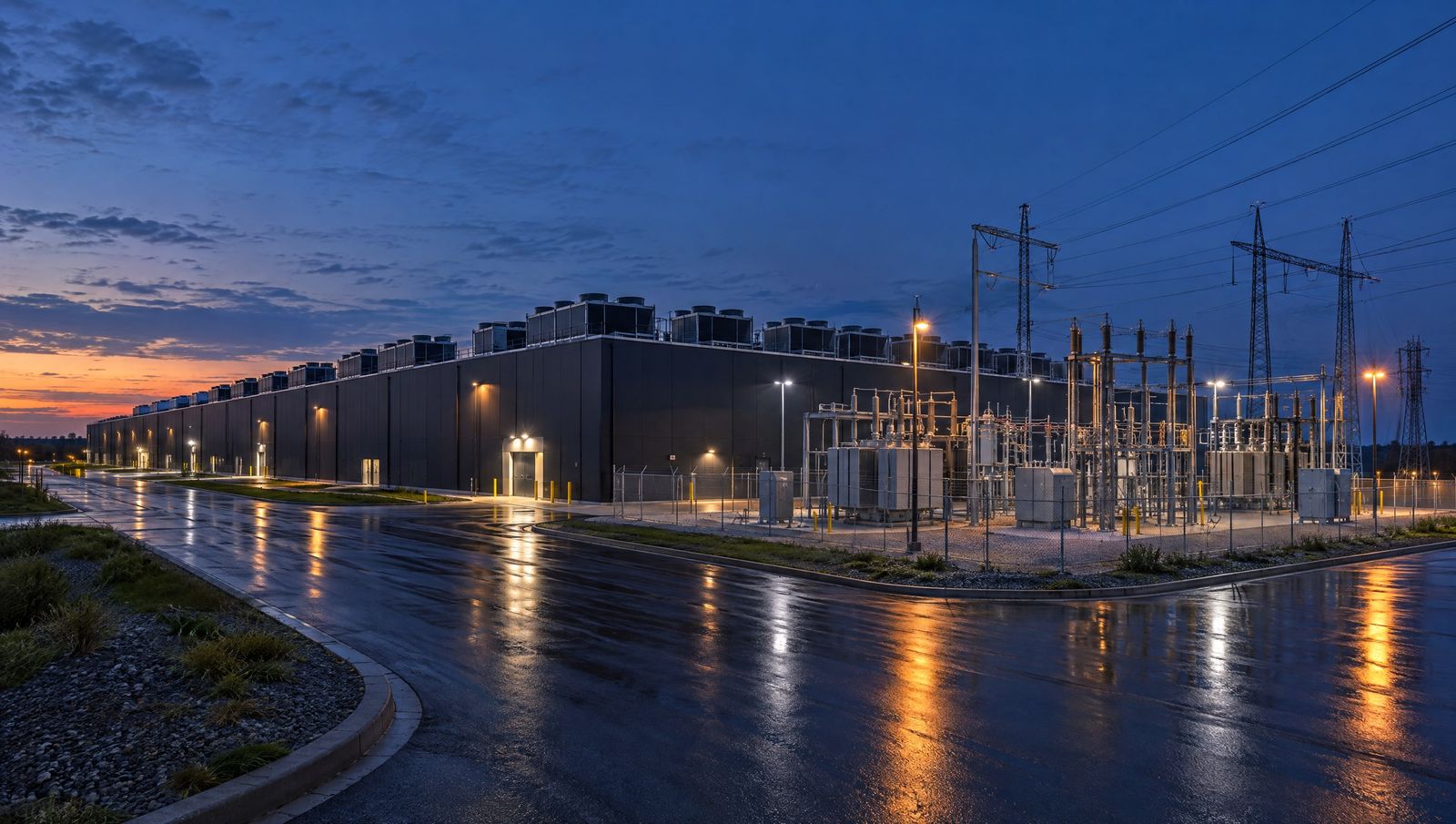
An AI data center draws power at every hour, and its owners judge the power plan first by uptime. That target, more than any single technology, decides the generation mix. Solar and wind supply energy with no fuel cost, but they follow the weather. A plan that has to meet a strict uptime target pairs them with storage and with firm sources that can run whenever they are needed.
If the first problem is getting power to a site at all, start with our look at planning power when the grid wait is five years. This piece picks up after that: how to put the pieces of the mix together.
Capacity Factor Shows the Gap
The U.S. Energy Information Administration (EIA) defines capacity factor as the energy a generator actually produced over a period, compared with what it could have produced running at full power the whole time. EIA’s preliminary figures for 2025 show the spread:
- Solar: 24.4%
- Wind: 34.2%
- Hydropower: 35.3%
- Geothermal: 65.9%
A data center that runs around the clock needs far more hours of supply than solar or wind deliver on their own. That gap is what storage and firm generation fill.
Storage Moves Energy by Hours
Battery storage shifts solar into the evening. EIA reports that batteries able to discharge for four to eight hours typically cycle once a day, moving electricity to periods of high demand, such as storing midday solar for evening use. That covers the daily cycle well. A stretch of several cloudy, still days calls for sources that do not depend on a full battery.
Firm Sources, and Where Each Fits
Geothermal
Geothermal produces steady output from heat below ground, independent of weather. Today it depends on location: EIA notes that most U.S. geothermal plants are in western states and Hawaii. A 2024 Department of Energy (DOE) report, summarized by the American Public Power Association, found that newer technology that engineers reservoirs from hot rock could raise U.S. geothermal output about 20-fold and provide 90 GW by 2050, while the country will need 700 to 900 GW of additional clean firm capacity by then.
Hydro
A national laboratory study cited by DOE estimates the firm capacity of U.S. hydropower at over 24 GW and notes that hydropower plants can supply power to the grid immediately. A DOE assessment also found that existing dams without generating equipment could add more than 12 GW of capacity if fully developed.
Fuel-Based Thermal Generation
Thermal generation runs on fuel and can be dispatched at any hour, which makes it the most direct way to cover the hours that solar, wind, and storage leave open. It is matched to the fuel available at the site and sized to the load and the uptime target. Fuel supply, permits, and emissions all shape how large a role it plays.
Green Hydrogen, Where It Fits
Hydrogen made from renewable power can be stored and used later in fuel cells or turbines. DOE’s national hydrogen strategy names fuel cells and low-NOx turbines as a leading option for multi-day storage and dispatchable power. The trade-off is efficiency: a DOE storage handbook chapter from Sandia National Laboratories puts round-trip efficiency for electrolysis and fuel cell systems at around 40%, compared with 70 to 90% for lithium-ion batteries, while finding hydrogen cheaper than batteries for storage needs above about 12 hours. For more, see green hydrogen explained.
Putting the Mix Together
Start with the load shape and the uptime target, then work through the layers:
- Variable generation (solar, wind) for energy with no fuel cost.
- Storage to shift that energy into the evening and cover short gaps.
- Firm generation (geothermal, hydro, fuel-based thermal, or green hydrogen) for the hours storage cannot reach.
- The grid, where capacity exists, for added supply and backup.
The right proportions depend on the resources at the site, the fuel available, the interconnection path, and what each option costs over the life of the facility.
Where Solar Advantage Fits
Solar Advantage is an independent energy consultant. We handle capture: we find the energy need, shape the opportunity, and bring together developers, engineering and construction (EPC) firms in the United States, Canada, and India, and capital. The uptime target and load shape are where we start. You keep one point of contact from the first energy assessment through contract signing, and we stay involved while partners build and commission the project.
If you are planning a campus with a firm uptime target, share the site location, the load in megawatts (an estimate is fine), your timeline, and what is already in place (a site, a load estimate, an offtaker or tenant, or financing), and we will tell you what we would look at first.
Sources
- U.S. Energy Information Administration, Electric Power Monthly, Table 6.07.B: capacity factors
- U.S. Energy Information Administration, glossary: capacity factor
- U.S. Energy Information Administration, Duration of utility-scale batteries depends on how they’re used (2022)
- U.S. Energy Information Administration, where geothermal energy is found
- DOE geothermal report, summarized by the American Public Power Association (2024)
- U.S. Department of Energy, Hydropower Basics
- U.S. Department of Energy, Powering America’s Waterways (2012)
- U.S. Department of Energy, U.S. National Clean Hydrogen Strategy and Roadmap (2023)
- Sandia National Laboratories, DOE Energy Storage Handbook, Chapter 11: Hydrogen Energy Storage
This article is general information, not legal, tax, or financial advice. Each project is unique, and all information is subject to change based on project requirements.