
News & Insights · Residential · Insight
Wildfire Season and Home Backup Power
 By Ernie Delgado
· · 4 min read
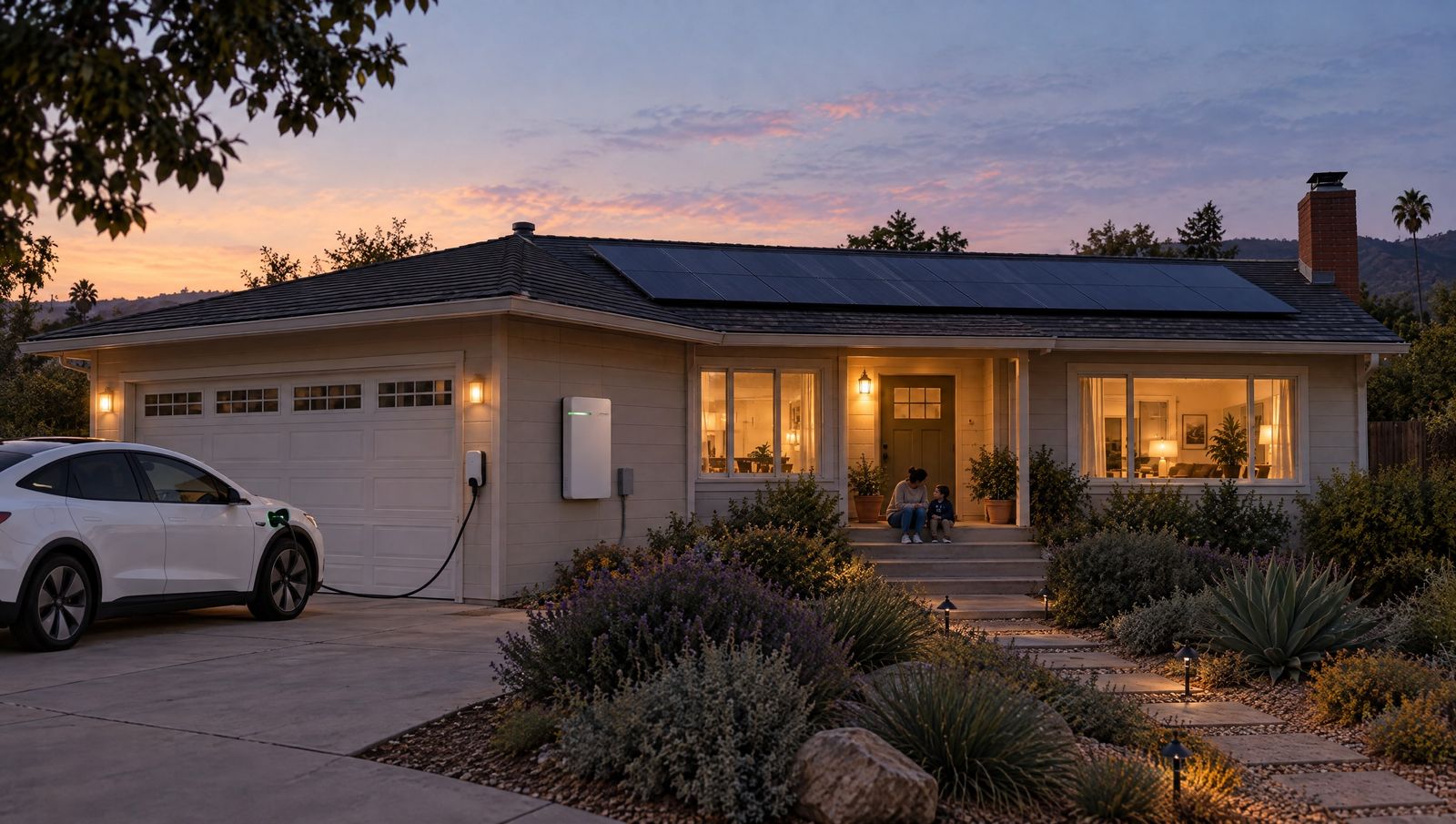
Strong winds, dry vegetation, and low humidity are the conditions that can lead a California utility to turn off power to reduce fire risk. If you live in or near a high fire-threat area, it helps to plan for these outages before they happen.
For Solar Advantage, this subject is personal. Our founder, Ernie Delgado, lost his home to a wildfire, and more recently he was in the path of a fire a second time.
What a Public Safety Power Shutoff Is
A Public Safety Power Shutoff, or PSPS, is when a utility temporarily turns off power to specific areas to reduce the risk of its equipment starting a fire. The California Public Utilities Commission describes it as a measure of last resort, used when there is an imminent and significant risk that strong winds may topple power lines or cause problems with nearby vegetation. Utilities also weigh dry vegetation, low humidity, and Red Flag Warnings from the National Weather Service.
How Long Outages Can Last
There is no fixed length. SDG&E says a PSPS can last from several hours to multiple days, and SCE says events may last over 24 hours. Power comes back only after crews confirm the lines are free of damage and debris, and those inspections need daylight. SCE says inspections typically take up to eight hours and can take longer.
Notice varies, too. SDG&E begins notifying customers about 48 hours before a possible shutoff, with a follow-up around 24 hours before. SCE notes that its forecasts might not capture a sudden onset of strong winds, so notice can be minimal or none. PG&E says that in some cases the first alert may come the same day the power is shut off.
What a Home Battery Can Keep Running
A battery can keep essentials like lights, medical equipment, refrigeration, and Wi-Fi running when grid power is unavailable. Paired with solar, the system disconnects from the grid during an outage and works on its own, and the panels charge the battery during the day. That is what makes solar and storage useful in a shutoff that lasts more than a day. Solar without a battery is designed to shut off automatically during an outage.
There are limits. How long backup lasts depends on battery size, how much energy you use, and whether you have solar. At night or on cloudy days, the panels may not be able to recharge the battery. Air conditioning and space heaters use a lot of power, and some appliances cannot be backed up because they use more power than the battery can supply. For a plain-language look at sizing, see what stays on during an outage, and how to size a home battery.
Planning Tips Before Fire Season
- Keep your contact information current with your utility so alerts reach you. PG&E also offers Address Alerts for places such as a school or a parent’s home.
- Ask about medical programs. If you rely on power for health and safety, PG&E points customers to its Medical Baseline Program and Vulnerable Customer Status. SCE’s Critical Care Backup Battery program offers free portable backup batteries for medical devices to eligible customers.
- Raise your battery’s backup reserve before wildfire season so more energy is saved for outages. Some storage providers can also signal a battery to fully charge ahead of time.
- Charge your electric car fully when a shutoff is possible.
- Refresh your emergency kit with flashlights, batteries, a first-aid kit, and cash.
A Note on Fire-Area Battery Incentives
California’s Self-Generation Incentive Program (SGIP) set up an Equity Resiliency budget for batteries at eligible homes in Tier 2 and Tier 3 high fire-threat districts that also met another test, such as a medical need, and later for customers who had been through two or more shutoffs. As of October 10, 2026, the program’s own tracker lists that budget as closed, and SCE says SGIP’s ratepayer-funded budgets are closed to new applicants. Ask your utility about current programs before counting on an incentive.
How Solar Advantage Helps
We sit down with you, look at your home, your bills, and your outage plan, and determine the solution that will give you the best savings and the backup you need. We work with several licensed installation partners, so we can match you with the right one, and that partner designs, permits, and installs it. Your contract is with that partner. Residential sales are made by Ernie Delgado, California Home Improvement Salesperson Reg. No. 134510SP.
Want backup power in place before the next fire season? Get a quote. If you already have solar, check the box that says so.
Sources
- California Public Utilities Commission, Public Safety Power Shutoffs
- SDG&E, Public Safety Power Shutoffs
- Southern California Edison, Public Safety Power Shutoffs
- PG&E, Public Safety Power Shutoffs
- PG&E, residential battery storage
- Energy Trust of Oregon, solar and storage for home resilience (2024)
- Southern California Edison, Self-Generation Incentive Program
- California Public Utilities Commission, Self-Generation Incentive Program
- Self-Generation Incentive Program, program metrics and budget status
- pv magazine, California battery backups in high fire threat districts (2019)
This article is general information, not legal, tax, or financial advice. Each project is unique, and all information is subject to change based on project requirements.