
News & Insights · Residential · Insight
What Stays on During an Outage, and How to Size a Home Battery
 By Ernie Delgado
· · 4 min read
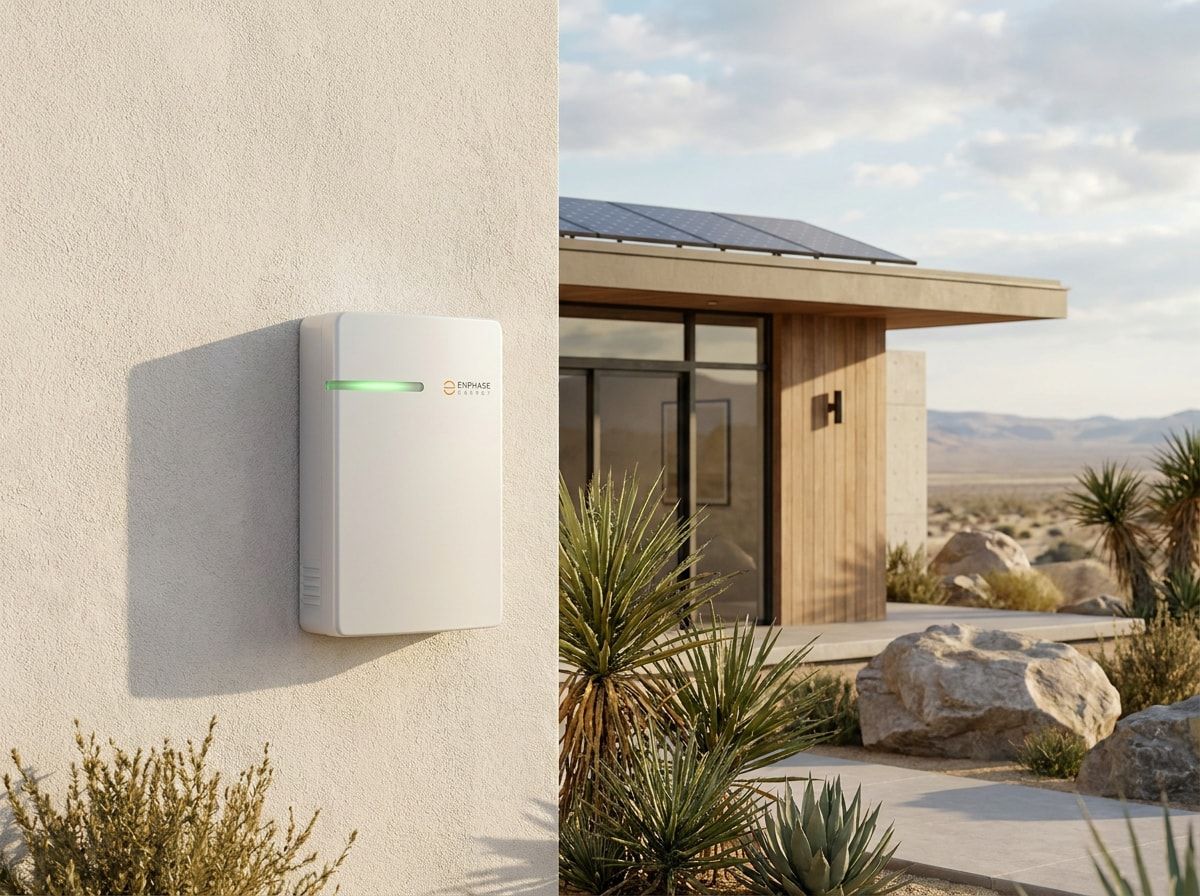
When the grid goes down, a home battery keeps the circuits you choose running. Which circuits, and for how long, comes down to two numbers on the battery’s specifications and a few decisions about your home.
Essential Circuits or the Whole Home
There are two broad approaches.
- Essential circuits. The battery backs up a selected set of circuits, such as the refrigerator, lights, Wi-Fi, medical equipment, and a few outlets. You decide what is essential, and fewer loads mean the battery lasts longer.
- Whole-home backup. The battery covers everything in the house. That is more convenient, and it takes more battery. Air conditioning and space heaters use a lot of power, and some appliances cannot be backed up because they use more power than the battery can supply.
Either way, that choice drives the size of the system.
kWh and kW in Plain Terms
Batteries are rated in two ways, and both matter.
- Kilowatt-hours (kWh) measure energy, or how much the battery can store. One kWh is one kilowatt used for one hour. The U.S. Energy Information Administration gives this example: a 40-watt light bulb used for five hours uses 200 watt-hours, or 0.2 kWh.
- Kilowatts (kW) measure power, or how much the battery can deliver at one moment. One kilowatt equals 1,000 watts.
Think of kWh as the size of the tank and kW as how fast it can pour. A battery needs enough kWh to last through the outage and enough kW to run everything that is on at the same time.
A Simple Worked Example
The figures below are illustrative only. The refrigerator line uses the U.S. Energy Information Administration’s 2020 household survey, which puts the average most-used refrigerator at 617 kWh a year. The other lines use typical wattages and an estimating method published by Virginia Cooperative Extension: multiply an appliance’s wattage by the hours it runs each day, then divide by 1,000 to get kWh per day. Your own appliances will differ.
- Refrigerator: 617 kWh a year divided by 365 days is about 1.7 kWh a day.
- Lights: four 40-watt bulbs (160 watts) for 5 hours is 0.8 kWh.
- Flat-screen TV: 120 watts for 4 hours is 0.48 kWh.
- Laptop: 50 watts for 8 hours is 0.4 kWh.
- Microwave oven: 1,100 watts, the top of the listed range, for 15 minutes is about 0.28 kWh.
Here is what that example shows:
- Energy. Running this list for one day with no solar takes about 3.6 kWh of usable storage. The refrigerator is the largest single item.
- Power. The lights, TV, laptop, and microwave together draw 1,430 watts. A refrigerator also draws power while its compressor runs, and the extension’s older table lists one model at 725 watts. Counting that figure, everything at once comes to at most about 2.2 kW, and the battery has to deliver that much at one time.
- One large load changes the math. Add a 1,500-watt portable heater for four hours and the day’s total rises by 6 kWh, to about 9.6 kWh, more than double. The peak draw climbs to about 3.7 kW.
Recharging From Solar
During an outage, a solar and battery system disconnects from the grid and works on its own, and the panels charge the battery during the day. That can stretch backup across an outage that lasts more than one day. Solar without a battery is designed to shut off automatically during outages.
Recharging has limits. At night or on cloudy days, the panels may not be able to recharge the battery. A good plan looks at the battery and the solar that refills it together.
Why the Proposal Spells It Out
How long backup lasts depends on battery size, how much energy you use, and whether you have solar. Those are specific to your home, so the numbers belong in writing. Your proposal should state:
- The battery’s usable storage in kWh and its power rating in kW
- Which circuits are backed up, or whether it covers the whole home
- Any appliances that will not be backed up
- How solar recharges the battery during an outage
How Solar Advantage Helps
We sit down with you, look at your bills and what you want backed up, and determine the battery solution that will give you the best savings and the backup you need. We work with several licensed installation partners, so we can match you with the right one, and that partner designs, permits, and installs it. Your contract is with that partner. Residential sales are made by Ernie Delgado, California Home Improvement Salesperson Reg. No. 134510SP.
To see what a battery could keep running in your home, get a quote. If you already have solar, check the box that says so.
Sources
- U.S. Energy Information Administration, measuring electricity
- U.S. Energy Information Administration, 2020 Residential Energy Consumption Survey, household electricity end-use averages (Table CE5.3b)
- Virginia Cooperative Extension, estimating appliance and home electronic energy use (2020)
- PG&E, residential battery storage
- Energy Trust of Oregon, solar and storage for home resilience (2024)
This article is general information, not legal, tax, or financial advice. Each project is unique, and all information is subject to change based on project requirements.