
News & Insights · Commercial & Municipal · Insight
Why DC Fast Chargers Can Drive Up a Dealership's Demand Charges, and How a Battery Trims Them
 By Ernie Delgado
· · 4 min read
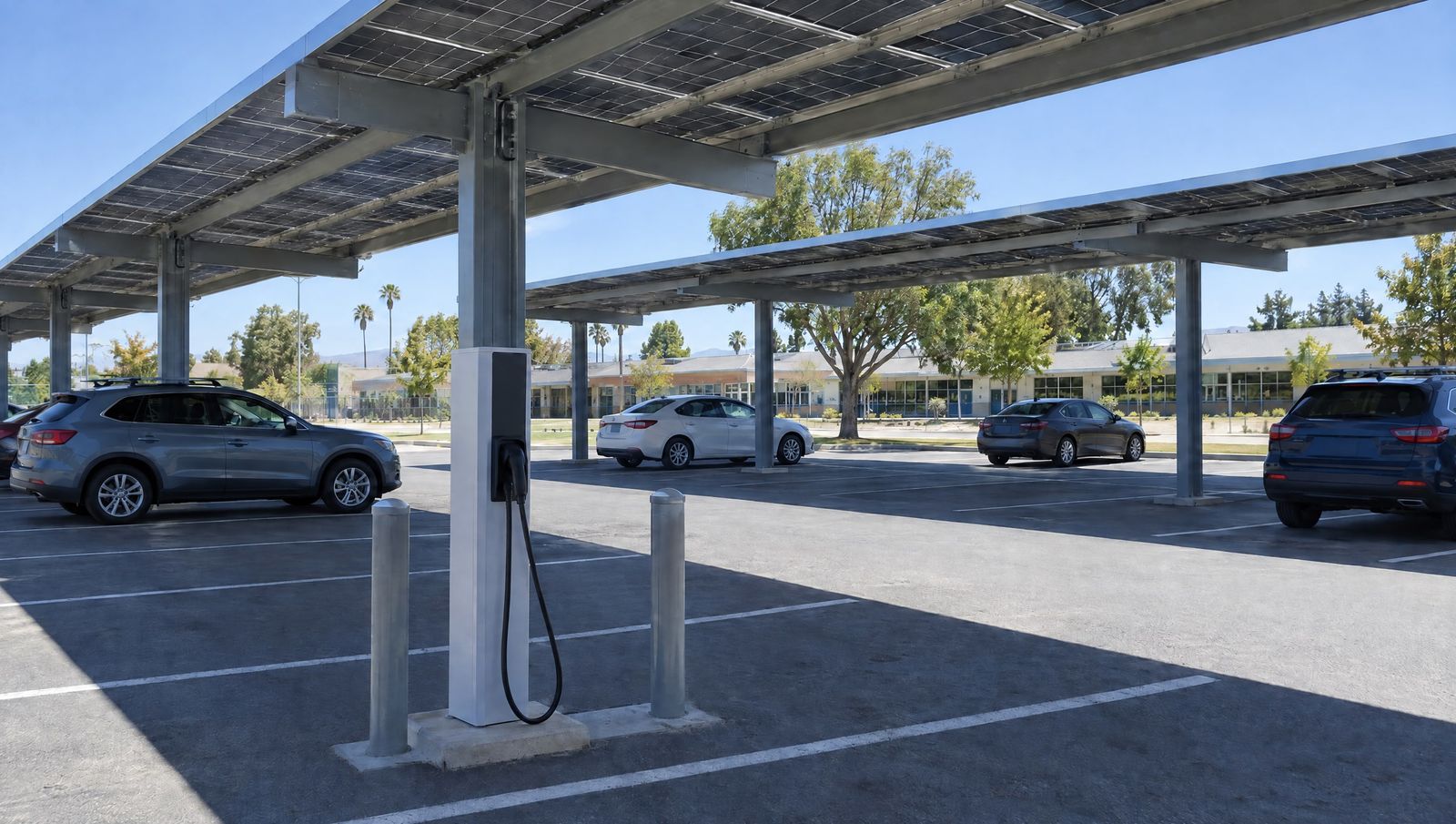
A DC fast charger is one of the largest single loads a dealership can add. The energy it uses is part of the cost. The bigger surprise is often the demand charge, which can be set by a single busy afternoon.
What a Demand Charge Is
Commercial electric bills usually charge for two things. Energy, in kilowatt hours, is how much electricity you use over the month. Demand, in kilowatts, is the rate at which you use it at a given moment.
One California utility measures maximum monthly demand as the highest kW peak in any 15-minute interval. The demand charge is that peak multiplied by a price per kW, so one 15-minute spike sets the charge for the whole month. That same utility also bases one demand charge on the higher of the month’s peak or 50% of the highest peak in the past year, so a spike can keep showing up on later bills.
Demand charges often make up 30 to 70 percent of a commercial customer’s monthly electric bill. A survey of U.S. demand charges by the National Renewable Energy Laboratory (NREL) and Clean Energy Group estimated that nearly 5 million commercial customers can subscribe to rates with demand charges above $15 per kW.
Why Fast Chargers Spike Demand
Early DC fast chargers were often capped at 50 kW. By 2021, most DC fast charging ports exceeded 50 kW, with some supplying up to 350 kW. Actual charging power varies by vehicle and by how full its battery is.
For illustration only: at a demand charge of $15 per kW, a 50 kW charger running at full power through one 15-minute interval could add about $750 to the month’s bill, and a 350 kW charger could add about $5,250. Your own figure depends on your tariff, the charger, the vehicles, and what else the building is running at that moment.
Low use makes it worse. A Rocky Mountain Institute analysis of fast charging stations found that demand charges can be responsible for over 90 percent of a station’s electricity costs, depending on the rate and how often the chargers are used. A charger that runs a few times a month still sets the peak, but sells little energy to spread that cost over.
How a Battery Shaves the Peak
A battery sits between the chargers and the utility meter. When a fast charger starts, the battery covers part of the load, so the meter sees a smaller peak. It then recharges at a lower draw, from solar or the grid.
Research led by NREL on fast charging costs found that battery storage alone is most useful for spiky, low-use loads. The same study found that solar mainly reduces energy charges, and that solar and storage together provide complementary savings. It also found that median electricity costs for fast charging stayed below $0.20 per kWh across more than 7,000 commercial rates, while some locations faced much higher costs.
How Managed Charging Helps
The Department of Energy lists managed charging practices that avoid increasing demand charges by reducing overlap with building loads, and that set a power ceiling across multiple chargers to reduce the need for upgraded equipment. Some utilities also offer managed charging programs, where the utility can raise, lower, or pause charging.
Check the Rate Before the Equipment
Utilities treat EV charging differently, so ask yours early. Some offer EV rates for business customers that replace traditional demand charges with a monthly kW subscription, and may require a separate meter for the chargers. The right mix of charger size, battery, managed charging, and rate plan depends on your tariff and how the chargers are used.
How Solar Advantage Helps
Solar Advantage is an energy consultant. We review your bills, rates, roof or lot, and electrical service; align the right engineering, equipment, and contractor team from vetted providers; and compare charger, storage, and solar options side by side against your actual tariff. We represent you through the proposal, financing, and contract, whether that is a PPA, a lease, or cash or a loan. A qualified, vetted contractor team, led by an engineering and construction partner, handles permitting and construction, and we stay your point of contact through the build.
Tell us about the site and what you pay for power today. Request an energy review, and you will know how fast charging would change your bill before you buy.
Sources
- San Diego Gas & Electric, understanding demand for business
- Clean Energy Group, survey of U.S. demand charges (2017)
- McLaren et al., NREL, a survey of U.S. demand charges (2017)
- U.S. Department of Energy, DC fast charging power levels (2021)
- DOE Alternative Fuels Data Center, charging station power levels
- Rocky Mountain Institute, rate design for public EV chargers
- Muratori et al., electricity cost for DC fast charging, Applied Energy (2019)
- U.S. Department of Energy, managed EV charging
- DOE Alternative Fuels Data Center, charging infrastructure procurement and installation
- Pacific Gas and Electric, EV rate plans for business
This article is general information, not legal, tax, or financial advice. Each project is unique, and all information is subject to change based on project requirements.